

Project restores historic colors and architectural details, bringing years of planning and preservation work to completion.
Galveston Historical Foundation (GHF) has completed a multimillion-dollar roof replacement at the 1892 Bishop’s Palace, marking the culmination of a preservation effort that began when the organization acquired the property in 2011. The project restores the roof’s historic colors and distinctive architectural details while protecting one of Galveston’s most recognizable landmarks for future generations.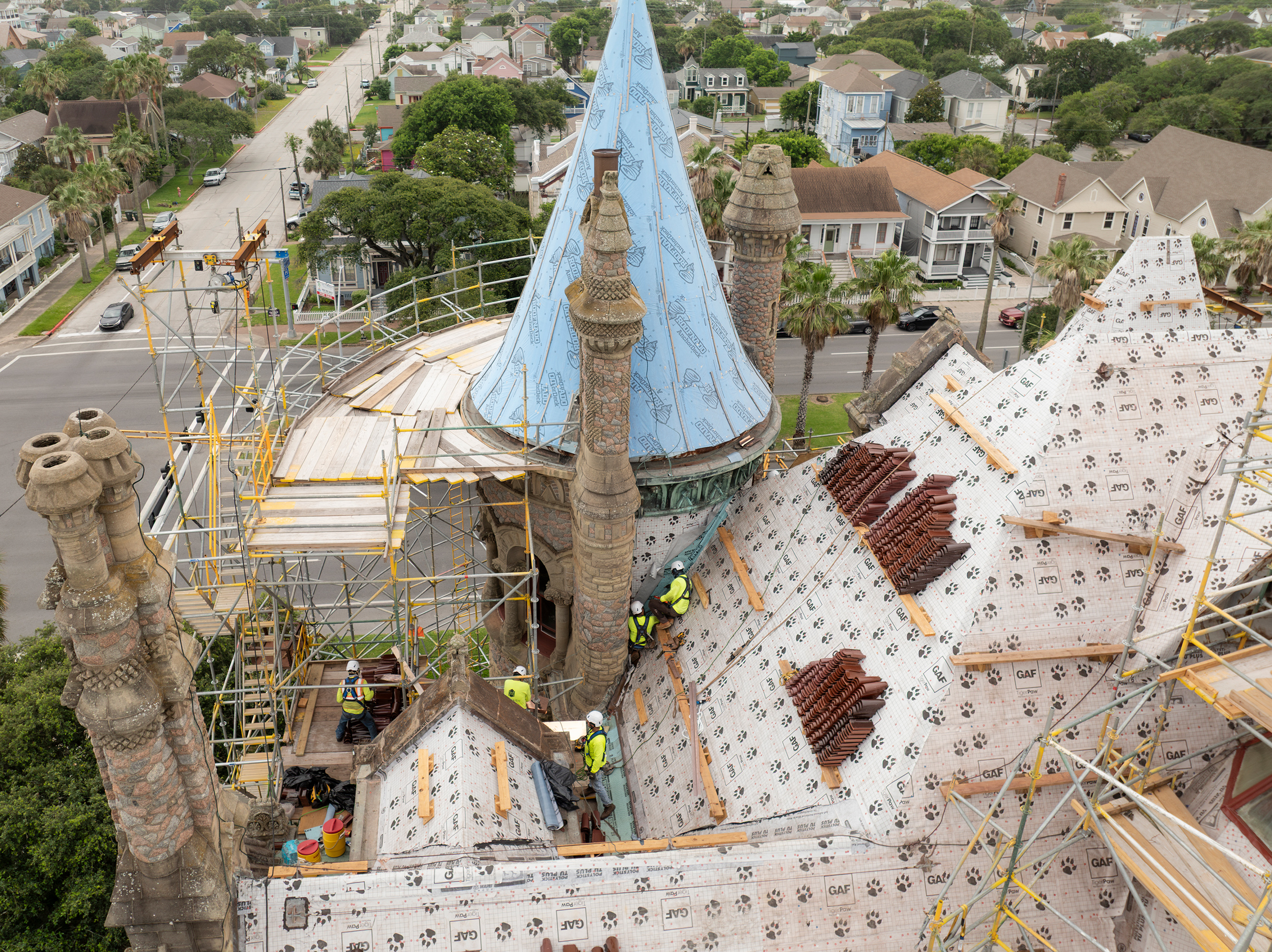 More than 40,000 terra cotta roof tiles, representing more than 20 varieties, were required for the project. The tiles were fabricated by New Lexington, Ohio-based Ludowici, a company with more than 130 years of experience in architectural terra cotta. Houston-based R.B. Hash, a Ludowici Crown Roofer, oversaw installation. Galveston’s HomeTown Bank financed the project.
“This has been a long time coming,” said Denise Alexander, Interim Chief Operating Officer of Galveston Historical Foundation. “We’ve wanted to restore the roof since we first took ownership of Bishop’s Palace, and we’ve spent years planning and doing the painstaking work to get here. Returning the roof to its historic colors and following Nicholas Clayton’s original drawings helps preserve what makes this house so extraordinary. We’re proud to see that commitment become a reality.”
The project marks the third roof in the property’s history, following a 1924 replacement that excluded the turret. Work also included installing four decorative hippocampi, mythical sea creatures envisioned by architect Nicholas J. Clayton. Earlier versions, which differed from Clayton’s designs, were lost over time. The newly created figures follow his original drawings, bringing his intended designs for these distinctive features to life for the first time.

Additional work included reinstalling lightning protection, guttering systems, and other components essential to protecting the building.
“The completion of this roof represents years of commitment to one of Galveston’s most significant historic landmarks,” said Will Wright, Interim Executive Director of Galveston Historical Foundation. “Our responsibility is to care for Bishop’s Palace with the craftsmanship, attention, and respect it deserves, ensuring that future generations can experience the history and artistry preserved here.”
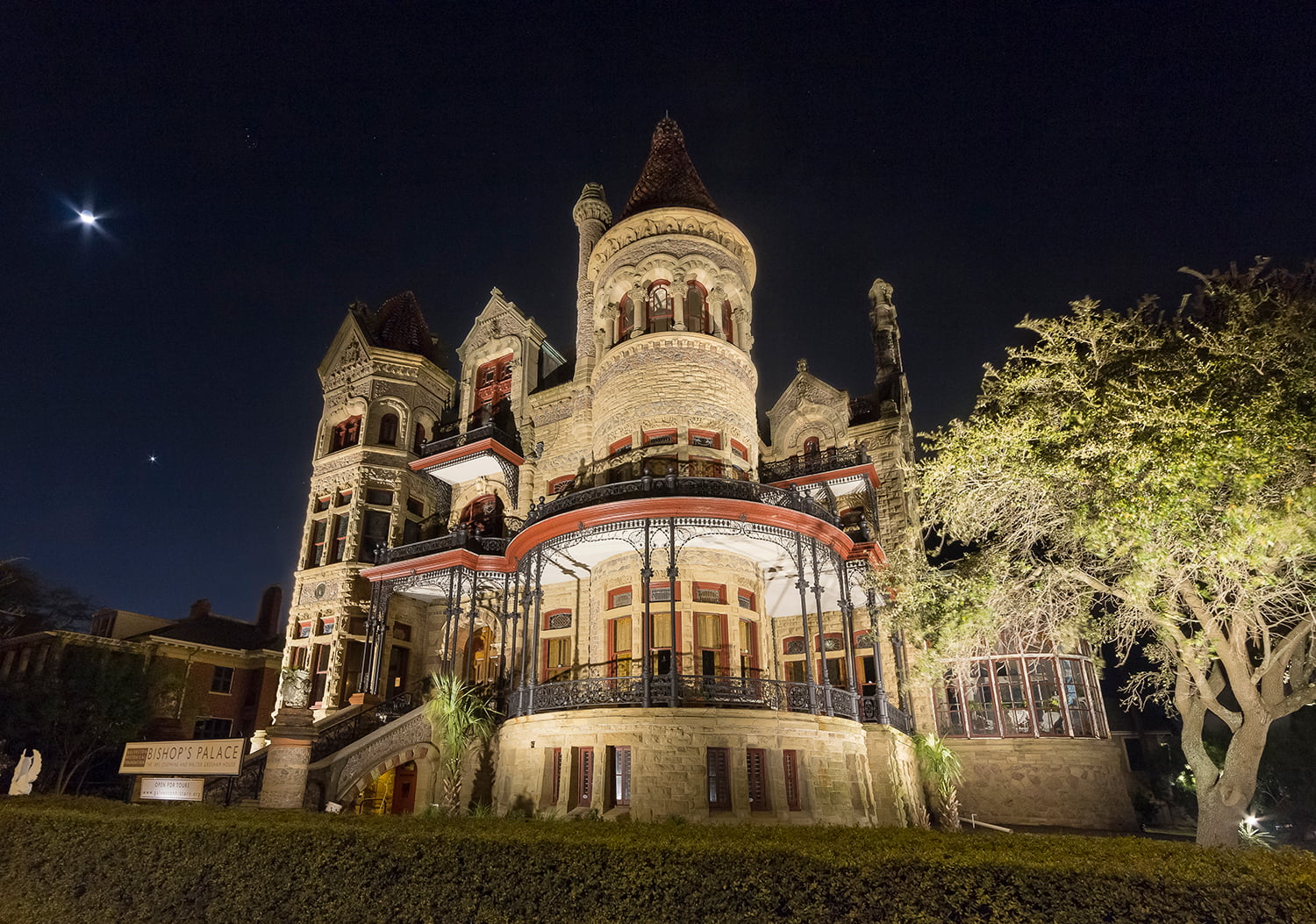 Bishop’s Palace, also known as the Gresham House, was constructed between 1887 and 1892 for attorney and civic leader Walter Gresham and his family. Designed by Nicholas J. Clayton, the elaborate Victorian residence reflects Galveston’s late-19th-century prosperity. It survived the 1900 Storm and was purchased by the Roman Catholic Diocese of Galveston in 1923 as a residence for Bishop Christopher E. Byrne, giving rise to its familiar name. Listed in the National Register of Historic Places in 1970, the house is today owned and operated by GHF as a historic house museum.
ABOUT GALVESTON HISTORICAL FOUNDATION
Galveston Historical Foundation (GHF) was formed as the Galveston Historical Society in 1871 and merged with a new organization formed in 1954 as a non-profit entity devoted to historic preservation and history in Galveston County. Over the last seventy years, GHF has expanded its mission to encompass community redevelopment, historic preservation advocacy, maritime preservation, museum development, and heritage tourism. GHF embraces a broader vision of history and architecture that encompasses advancements in environmental and natural sciences and their intersection with historic buildings and coastal life, and continues to lead on local, state, and national levels with research-driven programs that build awareness of preservation’s role in cultural identity and stewardship across generations.